top of page


mash filtering
(pressing)
.png)

When the process of main fermentation is complete, the moromi is filtered with cloth to remove the undissolved rice and yeast, separating the liquid- the new sake, from the sake cake (a.k.a. Sakekasu). There are different ways of conducting this process resulting in sake of different style and price.
As a rule of thumb, sake filtered with applying the least pressure is the premium, best-quality sake. On the contrary, the sake released at the end of the process after applying heavy pressure usually has a more bitter or astringent taste which is not desirable.
Names are assigned to the different batches of sake extracted as different stages. Most sake, unless otherwise stated is a blend of the different batches. You will see the below indication on the sake label if the bottle is made out of a specific batch of extraction.
.png)
Most sake in the market undergo this process using a machine to apply pressure vertically or horizontally to extract the liquid- which is called the Assaku-ki Press (压搾機).
Below shows some of the more special pressing techniques, which are normally indicated in the bottles.
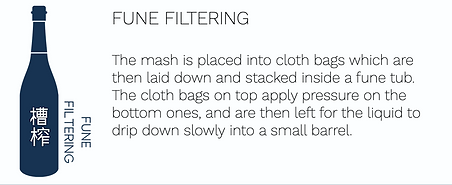


.png)
ROKA (Filtration)
When it comes to roka (filtration), it might not be as clear-cut as the rest of the steps. Every brewery might treat this term slightly differently. In general, after the pressing process which separates the sake liquid from the leftover rice solids (sakekasu), this process doesn't do much to the color or the flavor of the sake, leaving the sake at its original state with a straw-colored hue and often a bolder, rougher flavor profile. After pressing, most sake goes through a mechanical filtration system with a dose of powdered active charcoal to get rid of any impurity that could cause off-flavors or aromas, as well as to lighten the color of the sake to achieve its transparent, pure form.
As a loosely-agreed consensus in the industry, most sake goes through this charcoal filter process, unless stated otherwise. If you see "Muroka" (無濾過), highly likely that this sake hasn't gone through this charcoal filter process.
Click on the "Moroka" bottle above to learn more about its flavor profile.
.png)
bottom of page